Outputs
For .tc models, output and restart files use only the canonical TREF,
CS0/CS1, and DW0/DW1 coordinates. See
Temperature-dependent chemical shifts.
Location
By default, fitting results are saved in the Output/ directory. You can specify a different directory using the --output (or -o) option:
chemex fit -o <path> [other options]
Result Layout
For a single-step fit, the scientific result is written directly under the
output root. run_info/ independently describes how the invocation was made.
Output/
├── run_info/
├── Parameters/
├── Data/
├── Plots/
├── Grid/          # when GRID is requested
├── Statistics/
└── statistics.toml
If the fitting method has multiple steps, each step has the same authoritative result layout in a subdirectory named after that step:
Output/
├── run_info/
├── STEP1/
│   ├── Parameters/
│   ├── Data/
│   ├── Plots/
│   ├── Statistics/
│   └── statistics.toml
└── STEP2/
    ├── Parameters/
    ├── Data/
    ├── Plots/
    ├── Statistics/
    └── statistics.toml
ChemEx may internally factor a fit into independent fit components for efficiency. These are execution details, not separate user fits: component identity can appear transiently while minimization runs, but the method-step directory always contains the sole authoritative aggregate result.
Content
The output directory typically includes the following files and subdirectories:
run_info/
Records how the fit was started. run.toml contains runtime and command-line
metadata, resolved execution and software versions, archived input mappings,
optional Git details, and the root seed of each stochastic operation actually
started. parameters_used.toml is the immutable original invocation start:
it contains revision-zero values and configured bounds and reproduces the
original starting point. It is not updated after fitting.
After a state-changing fit commit, restart.toml is the latest committed
continuation state. It is atomically replaced after each later commit, so
there is one latest checkpoint rather than one checkpoint per method step. It
is an ordinary ChemEx parameter file and can be used directly with
chemex fit ... -p Output/run_info/restart.toml. A failed, rejected, stale, or
interrupted step does not replace the last successfully published restart. The
file is absent when the invocation has made no state-changing commit.
inputs/ contains verbatim byte copies of every user-provided experiment,
parameter, and method TOML file captured for the run. Multiple inputs remain
separate; both version 1 and version 2 method files are archived without a
normalized method artifact. Raw experimental data files are not copied.
outcome.toml is the lifecycle marker for the current invocation. It has
schema_version = 2 and a status of running, complete, or incomplete.
It always reports the latest in-memory committed revision and the latest
revision successfully published to restart.toml; these can differ if restart
publication failed after a scientific commit.
ChemEx writes complete only after every requested method step and statistics
analysis succeeds. Incomplete outcomes also identify the failure or interruption
when available. A process kill may leave running, which is not a successful
outcome.
When reusing an output directory, ChemEx clears its known result locations for
every currently planned method step before the first step starts. This includes
Parameters/, Data/, Plots/, Grid/, Statistics/, and statistics.toml.
Obsolete All/, Groups/, and Components/ result trees are also removed so
stale output cannot appear current; run_info/ and unknown user-created paths
are not cleared.
Partial new output can remain after a writer failure, but outcome.toml will not
report that invocation as complete.
Parameters/
Contains result reports as three files: fitted.toml, fixed.toml, and
constrained.toml, which list parameters that were fitted, fixed, and
constrained, respectively. These reports are not restart bundles. Use
run_info/restart.toml to continue from the latest committed state, or
run_info/parameters_used.toml to reproduce the original invocation start.
Example Files
- fitted.toml
- fixed.toml
- constrained.toml
[GLOBAL]
KEX_AB =  3.81511e+02 # ±1.23456e+01
PB     =  7.02971e-02 # ±2.10432e-03

[DW_AB]
15N =  2.00075e+00 # ±3.45678e-02
31N =  1.98968e+00 # ±3.21098e-02
An ordinary deterministic fit derives local covariance at its accepted point
from an exact retained optimizer Jacobian or an independent accepted-point
fallback, and displays covariance-derived standard errors when the evidence is
usable. Experimental observation uncertainties are interpreted as absolute
standard deviations, so ChemEx does not multiply covariance by reduced
chi-square. Reduced chi-square remains a goodness-of-fit diagnostic. Numerical
rank, boundary, normalization, derivative, or covariance-arithmetic failures
withhold errors with a concise reason. A large condition number is retained as
a weak-mode diagnostic rather than an arbitrary availability gate. MC, BS, BSN,
and MCMC summaries remain separate under Statistics/ and never replace these
errors.
[CS_A]
15N =  1.19849e+02 # (fixed)
31N =  1.26388e+02 # (fixed)
[GLOBAL]
KAB =  2.68192e+01 # ±1.10421e+00 ([KEX_AB] * [PB])
KBA =  3.54692e+02 # ±1.14863e+01 ([KEX_AB] * [PA])
Applied constraints are provided in comments. ChemEx propagates the accepted local covariance through supported arithmetic constraint expressions and shows the resulting covariance-derived standard error. Scientific-function expressions without a qualified analytic derivative fail closed for that derived error; fitted independent-parameter errors remain available.
Plots/
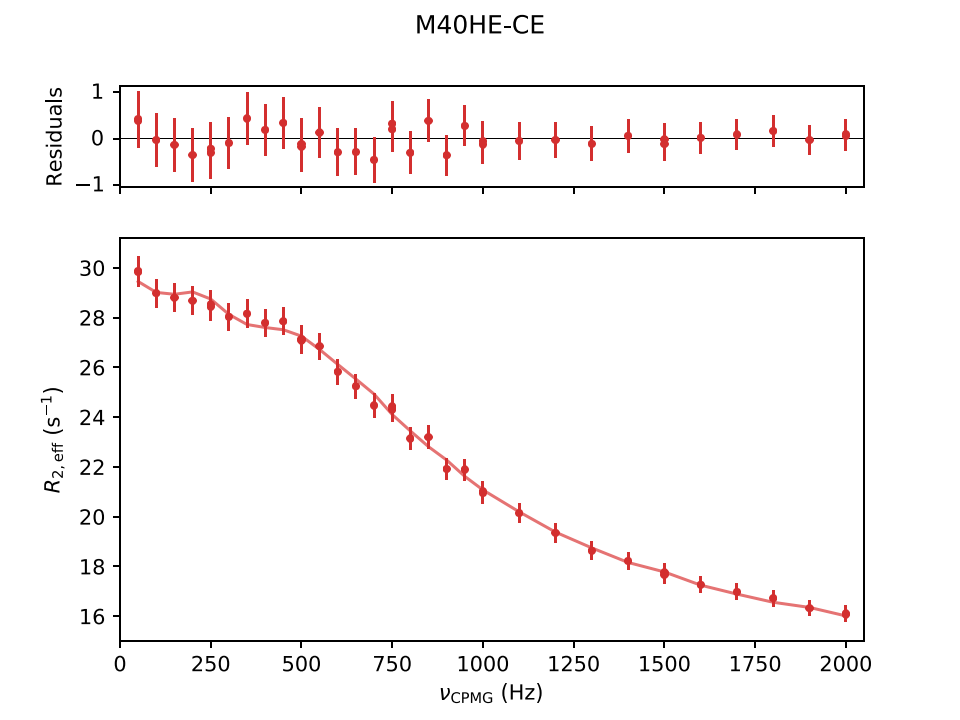
Contains .pdf plots of the fitting results, along with the raw input and fitted data points. Example plots for CPMG and CEST experiments are shown below:
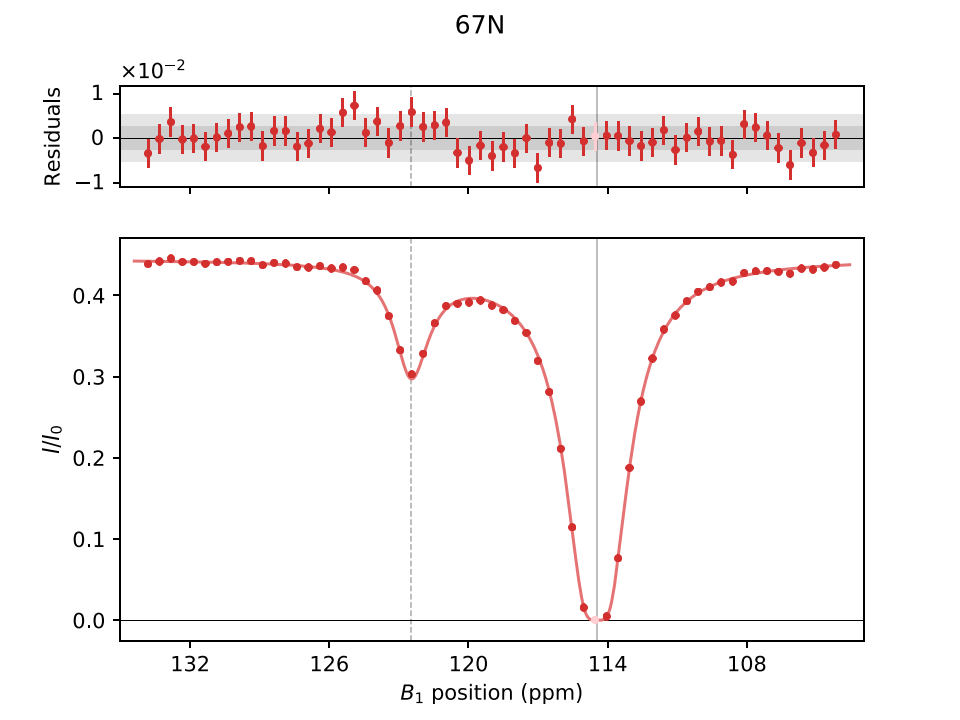
In (D-/cos-)CEST plots, vertical-line styles follow stable ChemEx state-label
order: A uses the first, solid style, while B, C, and later labels use the
subsequent dash and dot patterns. The styles do not encode physical state
identity, population, or energy. See
Exchange States and Parameters for the label
convention. "Folded" positions are marked with *.
Data/
Contains data values used in the fitting process along with back-calculated values for calculating χ2.
[15N]
#         NCYC   INTENSITY (EXP)       ERROR (EXP)  INTENSITY (CALC)
             0    3.47059800e+04    1.77491406e+02    3.47055362e+04
Grid/
When a method requests GRID, ChemEx publishes the raw exact factor grids,
machine-readable profile surfaces, plots, and the coherent selected grid state:
Grid/
├── Factors/
│   ├── factor_01__<axes>.tsv
│   └── ...
├── Profiles/
│   ├── 1D/
│   │   ├── <parameter>.tsv
│   │   └── ...
│   └── 2D/
│       ├── <parameter1>__<parameter2>.tsv
│       └── ...
├── grid_1d.pdf
├── grid_2d.pdf
└── summary.toml
Each deterministic factor filename identifies its concrete grid axes and a
compact experiment/profile key. Its TSV includes the full profile membership,
coordinate values, profiled chi-square, point status, selected flag,
objective-evaluation count, and a failure description when applicable.
Thus a failed or unavailable point is distinct from a valid point with a large
finite chi-square. The Profiles/1D/ and Profiles/2D/ TSV files contain the
same exact reduced surfaces shown in the PDFs, including a marker for the
selected coherent joint solution. summary.toml records its freshly validated
aggregate chi-square and concrete grid-axis assignment.
ChemEx writes a 1D profile for every concrete GRID coordinate. A 2D profile is
written only when both coordinates coexist in at least one exact GRID factor;
cross-factor local/local pairs are omitted because they do not add a directly
sampled joint landscape. The corresponding grid_2d.pdf is absent when no such
pair exists.
These factor files are numerical evidence, not independently authoritative
fits. ChemEx reconstructs one complete joint candidate from the exact factor
minimum, validates it against the complete root objective, and commits at most
once. Incomplete or interrupted GRID work does not publish ordinary fitted,
covariance, or statistics output as though it were complete. Reruns clear the
previous Grid/ tree before publishing a replacement. The former native
grid.out multistart layout is not written because it did not represent a
profiled chi-square surface truthfully.
Selected-coordinate DE is only an initializer for one normal full-coordinate
TRF fit, so it creates no separate DE result tree. Successful DE-assisted fits
use the same Parameters/, Data/, Plots/, Statistics/, and
statistics.toml outputs as an ordinary fit.
statistics.toml
Contains goodness-of-fit statistics, such as χ2.
"number of data points"                = 230
"number of variables"                  = 17
"chi-square"                           =  4.34555e+02
"reduced-chi-square"                   =  2.14067e+00
"chi-squared test"                     =  0.00000e+00
"Kolmogorov-Smirnov test"              =  6.66833e-02
"Akaike Information Criterion (AIC)"   =  4.88555e+02
"Bayesian Information Criterion (BIC)" =  5.81383e+02
"number of variables" reports the controlled optimizer coordinates (P).
Analytically fitted profile normalizations are not included in that field, but
they are fitted nuisance parameters (G) when calculating residual degrees of
freedom, the χ² goodness-of-fit test, AIC, and BIC. If N - P - G is not
positive, the reduced χ² and χ² goodness-of-fit result are serialized as nan.
See Scaling, Uncertainties, and Residuals
for the residual definition and the complete N, P, G, and ν convention.
Statistics/
Contains automatic deterministic covariance diagnostics as well as optional
uncertainty analyses requested with the STATISTICS method-file key.
Statistics/Covariance/evidence.json records the covariance policy,
accepted-point identity, parameter order, Jacobian/rank/conditioning/boundary
diagnostics, covariance-derived marginal errors, correlations, and typed
failures. Statistics/Constrained/evidence.json records supported constrained
propagation. ChemEx reports covariance-derived local standard errors when the
local covariance is otherwise valid, including when the accepted fit is near or
at a parameter bound. In that case, affected parameter comments warn that the
boundary may make the uncertainty asymmetric because the symmetric Gaussian
approximation can be imperfect. Profile likelihood or resampling may be more
appropriate when accurate bounded confidence intervals are required. Inline
warnings are attached only to fitted coordinates near their own simple bounds
and to constrained outputs structurally depending on those coordinates;
aggregate boundary and affine diagnostics remain available in the evidence and
terminal status.
For fits with independent fit components,
Statistics/Covariance/blocks.json records any root-anchored independent-block
derivations used to isolate unavailable component covariance. If derivation is
interrupted after the fit commits,
Statistics/Covariance/status.json records the incomplete uncertainty stage.
Monte Carlo and bootstrap methods write summary.toml,
samples.tsv, correlations.tsv, diagnostics.toml, and plots.pdf under
Statistics/MonteCarlo/, Statistics/Bootstrap/, and Statistics/BootstrapNS/.
MCMC writes the same file set under Statistics/MCMC/, plus a plots.pdf
report with posterior distributions, walker traces, log-probability traces, and
autocorrelation diagnostics.
The diagnostics.toml files record execution details for reproducibility. MC,
BS, and BSN diagnostics include the native Direct TRF engine, root seed, and
effective worker count. An incomplete analysis instead writes the successful
sample rows, failures.tsv, and an explicit incomplete diagnostic; complete
summary, correlation, and plot files are suppressed. A failure while publishing
an MC, BS, or BSN summary, correlation table, plot, or final diagnostic likewise
retains only truthful completed sample/failure rows and atomically terminalizes
the diagnostic as incomplete. MCMC diagnostics also
include the direct emcee sampler engine, timing information, effective worker
count and root seed, acceptance fractions, burn-in decisions, and
autocorrelation estimates. When a completed chain is shorter than emcee's
recommended 50 autocorrelation times but supplies a finite positive tentative
estimate, automatic burn uses that estimate and the normal posterior products
are published. Diagnostics mark both the estimate and automatic burn as
tentative, retain the 50τ and 100τ recommendations, and withhold τ-derived ESS
and MCSE. Failed or interrupted MCMC suppresses every authoritative posterior
product. If automatic burn has no finite positive estimate or would leave no
retained samples, raw_chain.tsv preserves the completed sampler chain as
diagnostic evidence while diagnostics.toml explicitly marks the analysis
incomplete, distinguishes completed sampling from failed posterior retention,
and retains acceptance, autocorrelation, and timing diagnostics. The raw chain
is not a retained-posterior sample file. Other failures leave only the evidence
available at their failure stage and an explicit incomplete diagnostic. These
diagnostics are the best place to confirm that
--workers was applied as intended.
MC, BS, and BSN summary.toml files describe their empirical fitted-sample
distributions with the mean, median, standard deviation, 95% percentile bounds,
68% percentile bounds, and half_percentile_68_width. MCMC summaries describe
the posterior with the mean, median, standard deviation, 95% equal-tailed and
68% credible-interval bounds, and half_credible_interval_68_width.
mcse_mean, when available, is the Monte Carlo standard error of the estimated
posterior mean; it is distinct from posterior interval width. None of these
statistical summaries mutates the committed central fit.